
EcoSport Innovations advised a quarter of English Premier League clubs on surface selection. Read more...
Read MoreThe Challenge
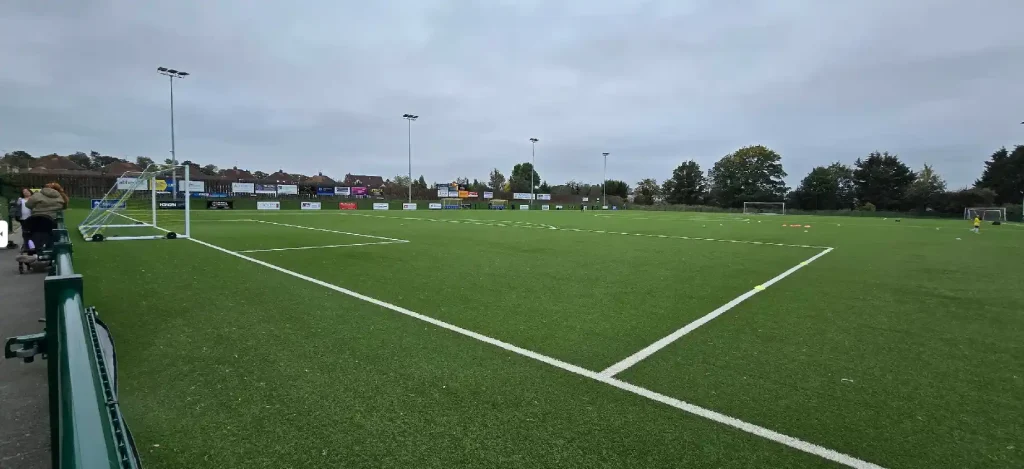
Monifieth Athletic FC is a youth football club and Scottish Charitable Incorporated Organisation (SCIO) based at Riverview in the town of Monifieth, near Dundee. With teams competing from under-9s through to under-19s, a coaching school for primary-aged children, and ambitions to establish a girls’ section, the club needed an all-weather training surface that could handle heavy community use year-round.
The problem was straightforward but significant: the club’s grass pitches were weather-dependent, limiting training during Scottish winters and reducing the hours available for community lettings. An all-weather 3G surface was the obvious solution, but the club’s leadership wanted more than a conventional rubber crumb pitch.
The other challenge we had to navigate was to convince Sport Scotland that out strategy was a good idea.

The challenge was threefold. First, the club needed to secure funding for a project that went beyond a standard specification. Second, no cork-infill pitch had ever been installed in Scotland, which meant navigating scepticism from funders and stakeholders about whether organic infill would perform in the Scottish climate. Third, the specification had to be right first time — a community club with limited resources cannot afford to get this wrong.
This is exactly the kind of challenge our feasibility and strategy service is designed to solve: assessing whether a project is viable, identifying the right specification, and building the case for funding — before a single turf fibre is laid.
What EcoSports Innovations Did
Funding Navigation and Stakeholder Negotiation
Monifieth Athletic FC secured £98,000 through sportscotland’s Sport Facilities Fund, part of a £1.25 million National Lottery investment across Scotland prioritising projects that increase participation among young people, women and girls, disabled people, and rural communities. EcoSport’s role was to support the club through the funding process and, critically, to negotiate with sportscotland on the specification.
Cork infill was not a standard specification in Scotland at that time. Convincing sportscotland to support a non-conventional system required evidence of cork’s performance in comparable climates, lifecycle cost analysis, and a compelling sustainability case. EcoSport brought direct experience from Newmarket Town FC — England’s first cork-infill pitch, also delivered with EcoSport’s involvement in 2016 — which had held FIFA Quality status since installation and demonstrated that cork performs reliably in a temperate maritime climate.
System Selection and Specification
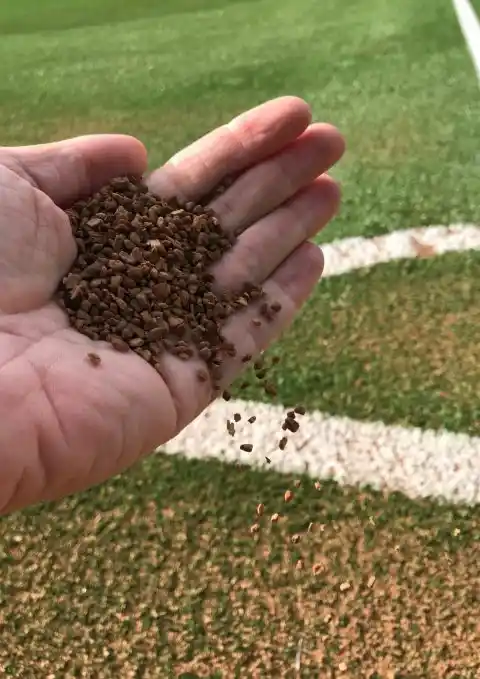
Choosing the right surface system is the decision that determines whether a pitch performs for five years or fifteen. EcoSport specified a system designed for the club’s specific usage pattern — heavy community use across multiple age groups — and for the local climate conditions. Cork infill offers several advantages over conventional rubber crumb: it is 100% organic and from a renewable source, it does not absorb water (critical for Scottish drainage), it is odourless even in enclosed or humid conditions, and it provides excellent cushioning and grip while reducing the risk of friction burns.
Cork also addresses the regulatory trajectory that every pitch owner now faces: the EU REACH restriction on rubber crumb infill takes effect from 17 October 2031. By specifying cork in 2021, Monifieth Athletic FC future-proofed their investment by a decade.
Delivery Partnership
The pitch was constructed by Fairways Sportsgrounds, a trusted contracting partner. EcoSport’s role through the delivery phase was specification oversight and quality assurance — ensuring the installed system matched the design intent and that the cork infill was laid to the correct depth and density for long-term performance.
Our quality assurance and testing service ensures that what gets built matches what was specified — an oversight step that many clubs skip, often at significant long-term cost.
Aftercare Guidance
Cork-infill pitches require different maintenance protocols to rubber crumb surfaces. EcoSport provided tailored aftercare guidance to the club, covering brushing frequency, infill top-up schedules, and drainage maintenance. This advice is critical: correct aftercare is the single biggest factor in whether an organic-infill pitch achieves its full design life.
The Outcome
The pitch was completed in 2021 and has been in continuous heavy use since installation. Years on, it still stands the test of time. That phrase that matters enormously in an industry where many pitches deteriorate visibly within three to four years of installation.
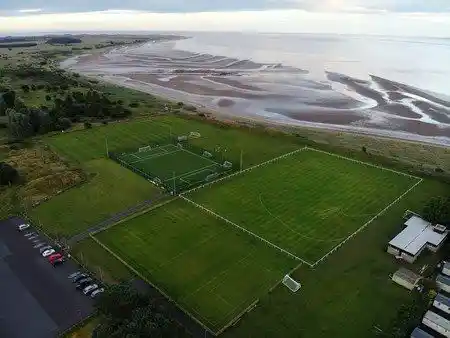
300+ players across all age groups now train on a year-round, all-weather surface.
Community access for the wider Angus area, supporting participation targets that secured the sportscotland funding.
Scotland’s first cork-infill pitch, establishing a precedent for sustainable surface specification north of the border.
Future-proofed against the 2031 EU REACH rubber crumb restriction — no transition planning required.
Still performing strongly under heavy use, demonstrating that cork infill works in the Scottish climate.
Why This Project Matters
Monifieth Athletic FC’s pitch is not just a facility upgrade — it is a proof point. Every time a club, school, or local authority in Scotland considers a new synthetic surface, the question of whether organic infill works in the Scottish climate comes up. Monifieth answers that question with years of real-world evidence.
Combined with Newmarket Town FC in England (cork-infill, FIFA Quality certified since 2016), EcoSport Innovations now has unrivalled experience of organic infill systems in the UK market. No other independent consultancy can point to this depth of evidence.
If you are considering a sustainable surface for your facility, speak to Nick directly — every project starts with a conversation.